

Safety
Using tools
8B2 Understand that screwdrivers, drills,
saws and files must be handled with care.
Understand that fingers should always be behind the blade of
hand tools.
 "Why do we have to understand
the dangers of hand tools ?" - Asked a student the other
evening. The answer is that the possibility of carrying out
construction of your own equipment, even in a small way is
now becoming a practicality, so
this is a general introduction to the dangers of
the most common of tools etc that might be used.
"Why do we have to understand
the dangers of hand tools ?" - Asked a student the other
evening. The answer is that the possibility of carrying out
construction of your own equipment, even in a small way is
now becoming a practicality, so
this is a general introduction to the dangers of
the most common of tools etc that might be used.
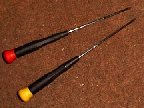
Even the humble screwdriver could cause up injury is it slips out of a screw head and hits your hand, for instance, so always consider what could happen and avoid accidents.

With the drill it is a little more obvious that injury could occur as a drill is intended to cut but ensure that it cut in the right place - such as a hole through metal wood etc.
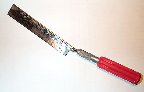
Again the saw is intended to cut so make sure it is only the piece that you are working on the is cut. Even a small saw like this one has a very sharp blade and with the small teeth can easily cut into your fingers etc !!!

Few people know about the damage that a file can cause if it does not have a proper handle. The handle end if a file has a pointed "tang" which is inserted into a handle and should the handle become detached and the operator uses the file with the handle they risk stabbing their hand with the file's tang. The file with its handle attached is shown in the picture below. Be aware that sometimes is the handle is wooden that it can dry out and slip off the tang leading to danger!!
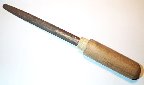
Remember to keep all actions where there is a chance of impact with hand, face or any other part of the body under proper control.
8B3 Understand that any items being drilled, sawn or filed must be securely held in a vice or similar device to prevent them slipping or rotating.
So that injuries are kept to a minimum, all items that are to be worked upon must be properly held so that they will remain held until the action that it carried out on them is completed.
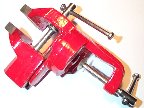
Dangers occur when items can slip or rotate.
The picture shows a small vice which is suitable for carrying in your tool box and fixing to a bench top (with suitable protection against scratching !!)
8B4 Understand that any locking keys, and/or chuck keys, must be removed before using a power tool such as a drill to prevent the key being ejected at high speed.
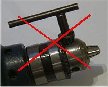
Many electric drills have what is called a chuck key. This is used to lock a drill bit into the chuck prior to drilling a hole. If the drill is started before the chuck key is removed then there is a great danger that the key will fly out, at high speed, and could impact any where and if this is with your body great injury could result.
8B5 Understand that using a centre punch will help prevent a drill bit slipping.
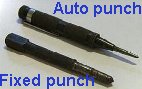
There is a simple tool called a centre punch which can greatly reduce the chance of a drill bit slipping on a material you want to drill.
By placing the tip of the punch on the point where you wish to drill a hole and smartly hitting the other end with a hammer a small indentation is formed that will "start" the drill in the right place and reduce slipping.
8B6 Understand the reasons why a bench-mounted pillar drill is safer than a hand-held drill.
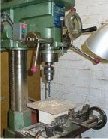
The hand drill is prone to moving about whilst you are drilling particularly large holes in thin metal. Thus it is much safer to use a pillar drill which holds the cutting drill steady and so long as the piece being drilled is held still the risk of injury is much reduced.
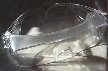
When drilling, especially metal, chipping called swarf, which are small particles, are thrown off and these would particularly cause eye damage. The risk is even greater when drilling brass as brass being none magnetic, if you did get swarf in your eye the surgeon could not use a magnet to help recover the swarf, which they might do with some steels which are magnetic.
IMPORTANT Information regarding Soldering
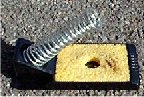
A soldering iron bit is the hot part and the stand is the relatively cool part. A soldering stand is used when the soldering iron is not in use to try to avoid contact between the soldering iron bit and your skin which would be readily burned.
The temperature of the soldering bit may reach 400C or even higher!
There are parts of even the soldering iron stand which get hot namely the spring,if the stand has one, into which the iron is placed. This spring also acts as a heat sink to take away heat from the tip and reduce decay and thus increases the life of the tip.
Also keep the cleaning pad in the stand damp - not soaking wet - so that you can readily clean the tip of the soldering iron.
NEVER have WATER near by when you are using mains electricity
** Keep that coffee cup away from your work area. **
When soldering fumes are given off from electronic solder which is a special type of solder which is called "cored" solder. The core holds the "flux" which enhances the cleaning of the surfaces to be joined. The flux when it becomes hot burns and gives off a vapour which should not be inhaled as there is the possibility of it causing breathing problems including asthma.
Eye protection must be worn when soldering to prevent solder from splashing into the eyes.
Both the flux and the solder is at very high temperature and both can spit if the surface of the board is damp due to the fact that the water quickly turns to steam and when mixed with the flux or solder created minor explosions or spitting.
Flux and solder must NOT be allowed to reach your eyes, else damage could occur so the wearing of protective goggles is necessary.
The origin of some of the text on this page is from the RSGB with additions by the web master