

Safety
Working at heights
A ladder should be used at the correct angle (4:1 height-to-base ratio).
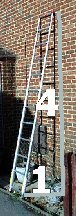
When working on a ladder to put up antennas etc remember the golden rule is 1 out for 4 up.
Or put it another way for every 1 metre the ladder is out from the wall you can be 4 metres up the wall.
How ever you want to remember it:- the golden rule is "1 out for 4 up".
Ladders must be secured at the top or securely held at the bottom by an adult to prevent the ladder from slipping.
When you are up a ladder, you have the chance to fall off if the ladder moves. Thus tie the ladder firmly at the top so that it cannot move and whilst doing that have an adult who knows what they are doing holding it at the bottom. Better still get two adults to make the ladder as safe as possible and let them do the necessary work - less fun but safer!
When you are on a ladder remember another golden rule :-
"Always have three limbs in contact with the ladder"
that will prevent you from over reaching. If you do over reach a ladder at least two things could happen:-
-
you fall off or
-
the ladder turns round and you end up on the under side wondering what on earth happened and thinking what you are going to do next.
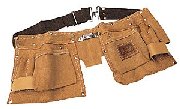
When working above ground level it is good practise to use some form of tool belt to hold tools that you are going to use. It means that the tools are :
-
to hand
-
are not left after you have come down
-
helps prevent them be knocked off a resting place down to the ground with the possibility of hitting the person holding the ladder !!
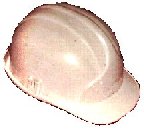
Now a hard hat is not a fashion accessory but it is an absolute necessity when working above ground or when you are standing below someone working overhead.
A falling tool would have a distinct possibility of cracking your skull if hit by a large spanner of hammer falling from above you.
Worth remembering:-
A dangerous electric shock can result from antennas and ladders coming into contact with or arcing from overhead lines.
You were introduced to dangers associated with electricity (mains) and (RF) in the Foundation Licence and whilst normally it is our friend to power our radios there is the danger of electric shock which can result from antennas and ladders coming into contact with or arcing from overhead lines. The potential arcing to occur is due to the ladder being at lower potential, that of the ground, than the voltages being carried by the wires and for the potential desire to flow into the lower level.
So don't try to erect :-
-
a metal mast right underneath a power line nor
-
try to tie an antenna to an overhead power cable or its support nor
-
work near an antenna wire which might be in use and the operator not know you are in the vicinity
The origin of some of the text on this page is from the RSGB with additions by the web master