

Safety
Electricity
8A1 Understand that large or high-voltage capacitors can store dangerous electric charges and must be discharged before working on equipment.
Recall that large value resistors can be used to provide leakage paths for these stored charges.
A capacitor has the ability of store a charge equal in voltage to that which is applied to "charge up" the capacitor. Which,if some means to discharge the capacitor, such as a "bleed" resistor, does not exist, the capacitor might well stay charged for a long time until natural leakage of the charge occurs. A bleed resistor is one which has a large value of resistance and is permanently connected across the capacitor terminals. If the voltage is 230V then the shock you would get from it would be the same as a mains electric shock. The danger would be even greater if it was a high voltage capacitor and a high value capacitor as the discharge would be immense.
Even a high value capacitor at low voltage say 12V could do a lot of damage it say a screw driver fell across it. It would be like a welding flash and probably burn the screw driver in half.
8A4 Recall that equipment mains fuses may be of a special type, such as quick blow or slow blow to allow for an initial surge of current and that the specified type must be fitted.
Understand that a fuse must be correctly rated for proper
protection, and, in the absence of manufacturer’s
instructions, to select an appropriate fuse.
For mains: current = power/230 where 230 is the nominal mains
voltage.
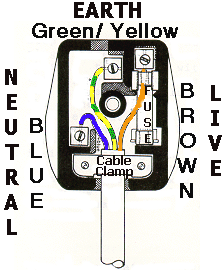
In the UK the nominal mains voltage is 230V AC.
Whilst you have not been asked to calculate the current rating of a fuse before - you are now. However this is only the most basic of calculation and to the purest it would not be considered correct but for the course you use the equation :-
current = power/230
So if you had a 230w bulb the bulb would be said to have an INPUT POWER of 230W.
Thus from the calculation current = power divided by voltage you get 230/230 = 1 amp. out of the choice of fuse 3,5 or 13 amp you would chose 3amp
Again if it was input power of 2300W fire you would use a 2300/230 = 10 amps you would then have to use a 13 amp fuse.
Now in the exam you will not be likely to have such easy calculation but the method is the same :-
fuse rating = power divided by the mains voltage of 230V
To re-cap mains plug fuses in UK come in three current ratings 3, 5 and 13 amps. The fuse rating that you chose will be the one which is just higher than the calculated value of the input current which has been worked out from the input power.
8A6 Understand that working on live equipment must only be done if it is not practicable to do otherwise and if the risks and appropriate precautions are fully understood.
It is not recommended to work on live equipment for fear of electric shock which can kill you. Never ever put your hands near live mains a.c. cables or circuitry. Should you need to read if mains voltage is getting through, you can measure it wearing insulated safety gloves and using a multimeter with long high voltage probes. Similarly you should not work on high voltages inside receivers or transmitters without similar precautions. You must understand that you make these measurements after checking for all possible risks then being ultra careful when making the measurements
8A8 Understand that vehicle batteries are a
source of very high currents which can start a fire and that
battery contents are corrosive.
Understand that explosive hydrogen gas can be given off when
charging batteries and that ample ventilation is required.
A vehicles battery can store a very high charge due to the fact a lot
of energy is required to start a vehicle's engine. This energy is
stored between plates inside the battery which are immersed in a
corrosive chemical. So measures must be taken if using such a battery
for amateur radio use. They are usually quite heavy and so you should
protect it from damage and also so it cannot be dropped and cause an
acid spillage. When connecting it up to your portable equipment make
sure you do not short the terminals because the high energy current can
all be released at once casing melting of metals such as wires, which
can also catch fire.
When charging your vehicle battery it may give
out fumes of hydrogen and oxygen which if exposed to a naked flame or
spark could explode and cause a lot of damage. The answer is to charge
your vehicle battery in a well ventilated area.
The origin of some of the text on this page is from the RSGB with additions by the web master