

Safety
Waveguides
 What is a waveguide
please ? asked one student the other night. So here is an answer:-
What is a waveguide
please ? asked one student the other night. So here is an answer:-
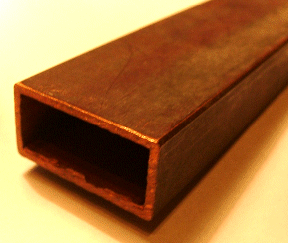
The photograph shows a section of "Waveguide". This piece has no flange on the end to join it to the next piece or to what would look like a rectangular funnel or horn as the end of a microwave antenna is called.
The waveguides are used in microwave transmissions lines. Unlike "normal" coaxial antenna the waveguide looks like the end of a flattened pipe and the microwaves shoot out of them usually into a dish or some other radiating antenna - just like a bullet comes out of a gun or water out of a hose.
So looking down a wave guide would be just like looking down the barrel of a gun and could be just as dangerous!!

The photograph shows a section of "waveguide" with flange on the end to join it to the next piece AND an "N" type connector to convert to Coaxial feeder.
Below you will see a complex piece of waveguide.

Hi-gain antennas
Hi-gain antennas are yagis where the RF is being concentrated in one direction (for the most part) and thus it is unwise to stand in front or near to the side off a yagi as the ERP will be several times as great as the power being fed to the antenna.
Further the higher the frequency the greater the risk.
Note Yagis are usually fed by coaxial feeder and thus are not to be associated with wave guides as a feeder to them.
So stand clear of ALL yagis and especially those at higher frequencies.
You have now reached the end of the Intermediate course! Well done!
Why not take our self-assessment test to see if you have understood well. Use the button below.